

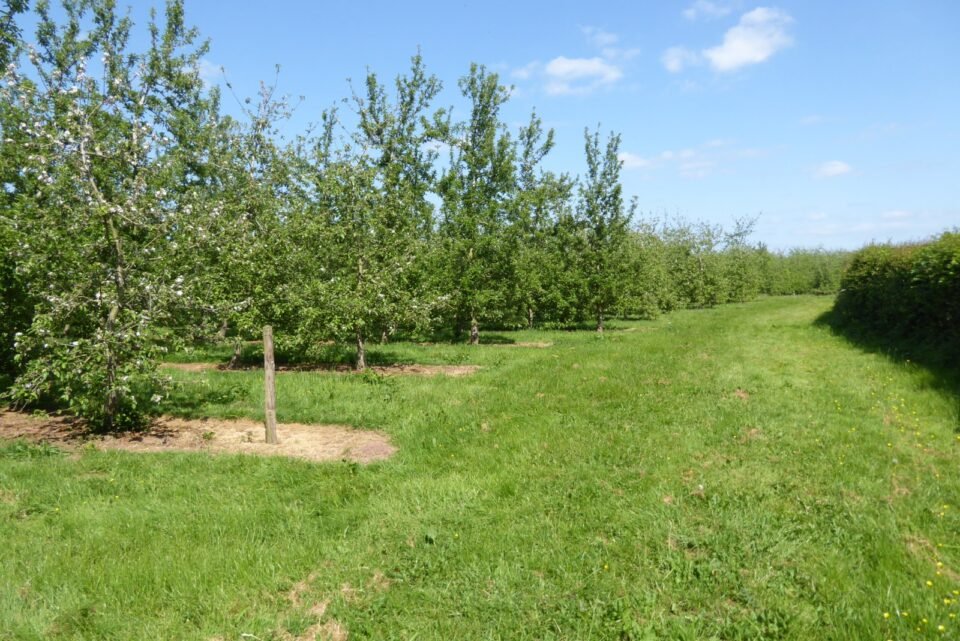
Apple orchards in Guba, a district in northern Azerbaijan long known for its fruit growing, have shrunk by nearly half over the past five years, falling from 13,518 hectares to 7,077 hectares, the Ministry of Agriculture says. This year, scab disease triggered by heavy rains has dealt an additional blow to local farmers’ incomes.
The total area under apple orchards in Guba fell by 47.6% between 2021 and 2025, according to figures released by Azerbaijan’s Ministry of Agriculture. The planted area dropped from 13,518 hectares in 2021 to just 7,077 hectares in 2025. On top of that long-term decline, this year’s wet weather fuelled an outbreak of scab disease that has hit farmers’ revenues hard.
Farmer Elshad Rustamov said that on his 1.5-hectare orchard, he would normally spray pesticide five or six times a season — but this year that number jumped to 15. The extra costs wiped out his margins: where he once earned 8,000-10,000 manats from the orchard, this season he ended up 5,000-6,000 manats in the red after expenses. He warned that if the trend continues, the traditional Guba apple variety risks disappearing altogether.
Another farmer, Teymur Seyfullayev, said his harvest from a similarly sized plot fell from 16 tons in previous years to just 6 tons this season. He added that the harvesting window was shorter than usual, and the sale price topped out at 70 qapik per kilogram. His farm ended up with losses of 7,000-8,000 manats.
Rain created conditions for disease to spread
The Ministry of Agriculture said prolonged rain during this spring’s flowering and fruit-setting period created ideal conditions for scab disease to spread rapidly. Around 4,500 hectares of apple orchards across the district were affected to varying degrees. The ministry stressed that infection does not automatically mean lost harvest — the scale of damage depends on how fast the disease spreads and how effectively it is treated.
The ministry has advised farmers to remove infected leaves and fruit from orchards and to properly shape tree canopies to improve air circulation. Simply spraying more often does not improve outcomes, officials said; what matters is choosing the right treatment and applying it at the correct time and dose.
Why the orchard area has been shrinking
According to the ministry, the main drivers behind the shrinking orchard area are the removal of ageing, economically unviable orchards and a shift by some producers toward cherries and peach-nectarine varieties. Between 2021 and 2025, 7,575 hectares of new fruit orchards were planted in the district, a figure covering all fruit rather than new apple orchards: 4,736 hectares went to cherries, 1,312 hectares to peaches and nectarines, and the remaining 1,527 hectares to other fruit varieties.
The ministry says gradually renewing old orchards and introducing disease-resistant varieties is essential. It estimates that, with proper agrotechnical practices, traditional orchards can yield 25-30 tons per hectare, while super-intensive orchards can produce more than 50 tons per hectare.
To cushion farmers’ risks, insurance and subsidy mechanisms have been rolled out. The Agrarian Insurance Fund said 705.91 hectares of apple orchards and saplings nationwide had been insured up to 2026, with total coverage reaching 11,743,374.99 manats. Farmers planting super-intensive orchards that meet regulatory standards are eligible for a planting subsidy of 11,000 manats per hectare.
Economist: losses go beyond the weather
Economist Asif Ibrahimli said the problems facing Guba’s apple farmers go beyond climate and disease. Rising costs, crop losses and limited access to sales markets are all squeezing incomes at once, he said, and this combination is wearing down the ability of small and medium-sized farms in particular to prepare for the next season.
Ibrahimli noted that when the entire harvest hits the market at the same time, it pushes prices down, while inadequate storage infrastructure forces farmers to sell immediately rather than wait for better terms. He pointed to a sharp gap between the price farmers get on the open market and the price processing companies pay, with farmers bearing most of the risk.
He also said small farms struggle to meet the sorting and packaging standards demanded by large retail chains, which gives imported produce an edge. Ibrahimli argued that building shared sorting and packaging centres in the region, adopting a cooperative model, and marketing Guba apples under a single brand could all help boost the sector’s competitiveness.
