

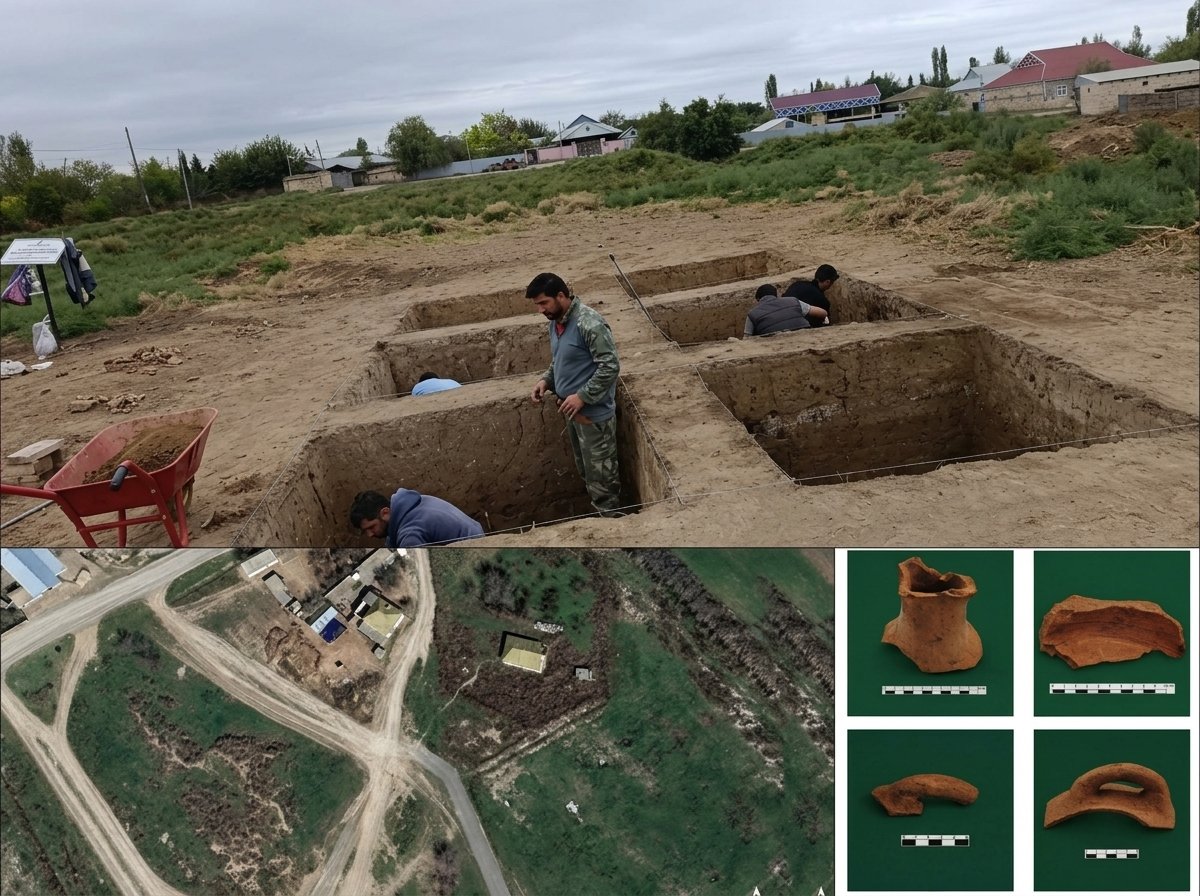
Archaeologists excavating the Tazakand site in Azerbaijan’s Beylagan district have uncovered the remains of old structures built from mud brick and fired brick. The findings show the settlement, located on the Mil plain, was inhabited in several distinct phases.
The Institute of Archaeology and Anthropology of the Azerbaijan National Academy of Sciences (ANAS) said the Tazakand settlement was studied by an expedition led by institute researcher Abdulla Abdullayev. The team surveyed the area in July 2026, dug a test pit in August and carried out full excavations from September 14 to October 13. Work in six squares showed the cultural layer runs to a depth of roughly one metre.
In excavation square A, at a depth of 97 centimetres, archaeologists found a floor laid with mud bricks measuring 40 by 35 centimetres. In square B, traces of fired red brick masonry were recorded at a depth of 92-93 centimetres. The team also recovered and catalogued pottery samples, building materials and bone remains.
What is known about the Tazakand site
The Tazakand monument was first identified in 1936 during a surface survey. The first systematic studies followed between 1953 and 1957, carried out by the Orangala expedition; in 1957 the cultural layer was found to extend to a depth of 3.5 metres.
Pottery fragments recovered in earlier digs, along with silver denarii minted during the reign of the Roman emperor Octavian Augustus, indicate the settlement was inhabited from the second-first centuries BCE through the fifth-seventh centuries CE. Researchers have identified the site with the remains of Paytakaran, an early medieval city.
