

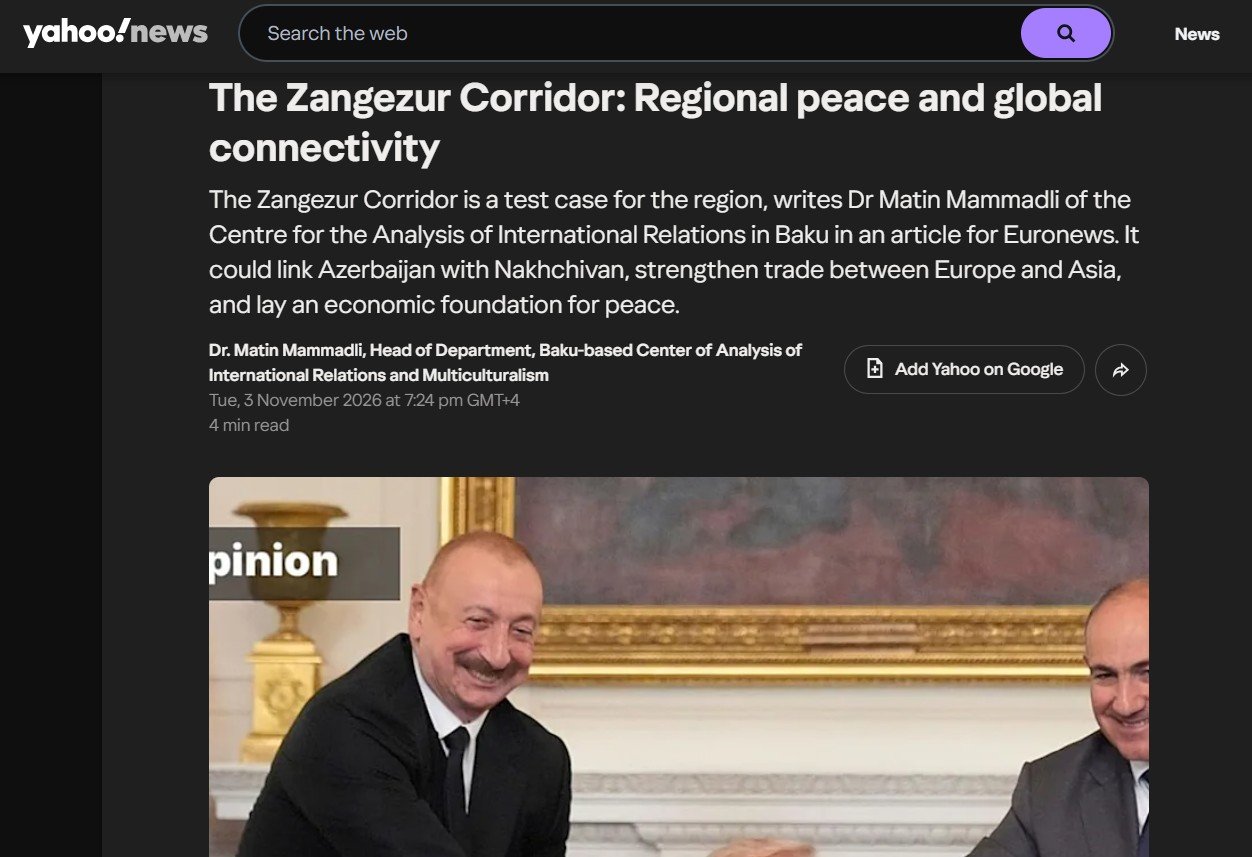
French news agency AFP distributed an article by Dr Matin Mammadli, head of Baku’s Center for the Analysis of International Relations, written for Euronews, arguing the Zangezur corridor could link Azerbaijan to Nakhchivan while boosting Europe-Asia trade and underpinning peace.
Dr Matin Mammadli writes that the Zangezur corridor carries significance far beyond providing a direct land link between Azerbaijan’s mainland and the Nakhchivan Autonomous Republic, and could reshape economic relations across the South Caucasus, according to the article distributed by AFP. The author recalls that point 9 of the Trilateral Statement signed on 10 November 2020 envisaged restoring transport links between Azerbaijan’s western districts and Nakhchivan, and notes that Baku has since argued that reopened connections could provide an economic foundation for peace.
The article cites the Horadiz-Aghband railway and highway projects as evidence that Baku treats connectivity as an investment priority rather than a diplomatic slogan. According to the author, the Washington agreements reached on 8 August 2025 with the participation of President Ilham Aliyev and Armenian Prime Minister Nikol Pashinyan gave the project fresh momentum; the Joint Declaration backed regional connectivity and the Trump Route for International Peace and Prosperity (TRIPP).
Middle Corridor and European interest
AFP’s dispatch says the Zangezur corridor should be viewed within the broader context of the Middle Corridor, which links China, Central Asia, the Caspian Sea, Azerbaijan, Turkey and Europe. Citing World Bank estimates, the author writes that coordinated investment and reforms could triple freight volumes along the Middle Corridor and halve transit times by 2030, though these figures apply to the corridor as a whole rather than to Zangezur alone.
The article notes that the European Union committed in 2024, together with partners, to mobilize 10 billion euros for Trans-Caspian connectivity, and that in January 2026 the EU and Azerbaijan raised cooperation on a feasibility study for a Nakhchivan railway. The author stresses this does not guarantee TRIPP’s success but underscores that the project aligns with European interests.
An economic basis for peace
According to Dr Mammadli, Armenia could become more integrated into international transport networks, Turkey could expand overland links with Azerbaijan and Central Asia, and China could gain additional access to European markets. The author writes that reopening long-closed connections could create day-to-day incentives for stability through trade and transit, though this alone will not resolve all political differences.
The article concludes that commercial viability, transparent governance, effective border procedures and sustained political commitment will determine whether TRIPP’s potential is realized.
Read also: Badamov: Passenger Traffic on TRIPP Corridor Possible Gradually
