

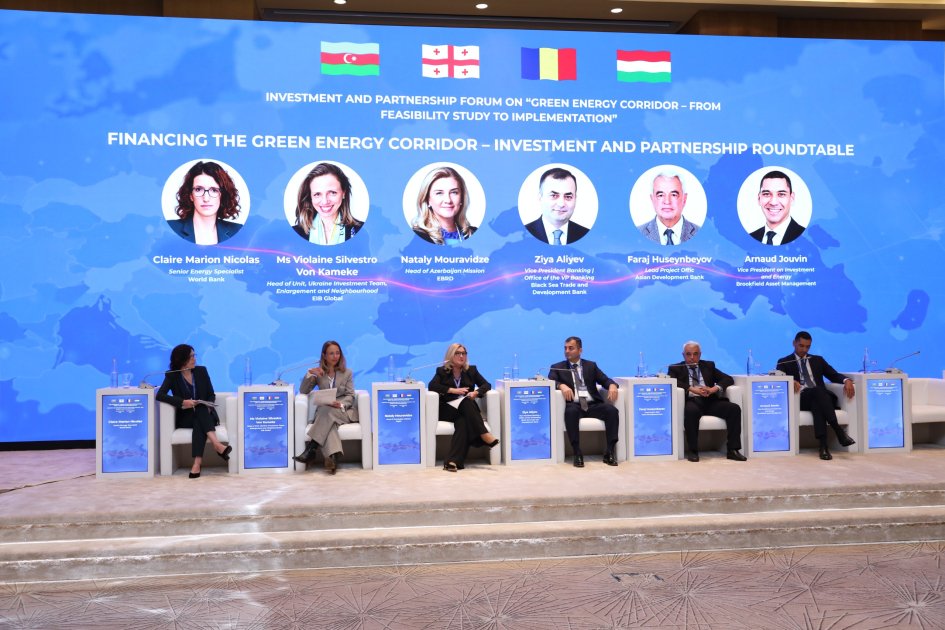
Azerbaijan’s Ministry of Energy has for the first time presented economic calculations for the Caspian-Black Sea-Europe Green Energy Corridor to foreign financial institutions and companies at a forum in Baku. A final investment decision on the project is expected in 2029.
A forum titled “Green Energy Corridor: From Rationale to Implementation” was held in Baku, where calculations for the Caspian-Black Sea-Europe Green Energy Corridor project were disclosed to foreign investment institutions for the first time. Participants discussed the project’s funding sources, business structure and potential new forms of cooperation.
Representatives of the World Bank, the European Investment Bank, the European Bank for Reconstruction and Development and the Asian Development Bank attended the gathering. Officials from companies including Brookfield Asset Management, ACWA Power, Masdar, SOCAR Green and Siemens Energy also took part.
Minister highlights project’s strategic role
Energy Minister Parviz Shahbazov said the project’s foundation was laid by an agreement signed by Azerbaijan, Georgia, Romania and Hungary in Bucharest in 2022. He noted that a feasibility study completed in July this year confirmed the project is viable both technically and financially.
The minister said the corridor plays an important role in President Ilham Aliyev’s drive to turn Azerbaijan into a regional hub for green energy. He also recalled that political support for the initiative was reaffirmed during the recent visit to Baku by European Commission President Ursula von der Leyen.
According to Shahbazov, efforts to include the project in the TYNDP 2026 document and secure Project of Common Interest status are making it more attractive to investors.
Technical parameters and expected results
The roughly 3,000-kilometre line is due to be gradually commissioned from 2032, with transmission capacity eventually rising to 4 gigawatts. Calculations suggest the project will help create at least 8 gigawatts of renewable energy generation potential in the region.
From 2040, the corridor could transmit around 20 billion kilowatt-hours of electricity annually to European countries, cutting carbon emissions by up to 3.6 million tonnes. Officials noted that laying cable at Black Sea depths of up to 2,200 metres will require advanced technological solutions.
To ensure financial stability, officials said a hybrid business model combining state regulation with commercial elements is being studied. The minister listed attracting international financial institutions and private investors, establishing a reliable operating model, and securing long-term commercial agreements as key conditions for reaching a final investment decision.
Six sessions held during the forum
The forum included six separate thematic sessions covering the project’s economic and technical indicators, business structure, electricity sales prospects, financing methods, risk insurance and technical equipment.
During the discussions, the company Jan De Nul presented new cable technology capable of operating at depths of more than 4,000 metres, saying the solution had passed testing successfully.
At the close of the forum, participants agreed on drawing up a cooperation roadmap and on the next steps toward a final investment decision.
Read also: Baku and Berlin broaden energy agenda: from gas supplies to green power | Azerbaijan to invest $2.6 billion in green energy by 2027
