

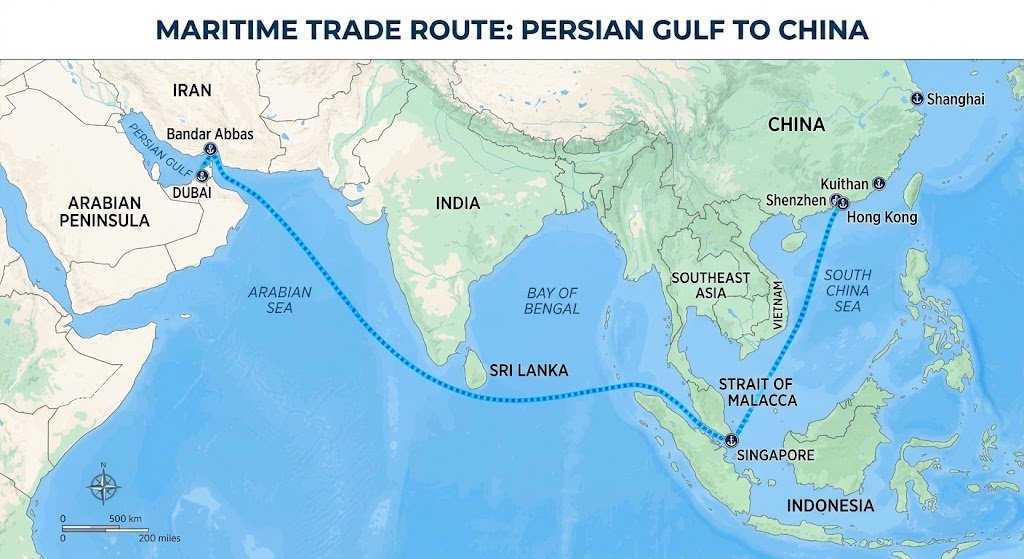
Freight rates for supertankers hauling crude oil from the Persian Gulf to China have surged roughly fivefold since the US-Iran military clash, according to foreign media reports. The spike has hit not only the Strait of Hormuz route but also alternative lanes that bypass the chokepoint.
Tanker rates on the Hormuz Strait route have climbed sharply since the military confrontation between the United States and Iran, with the TD3C route used by very large crude carriers seeing costs jump roughly fivefold. On February 27, before the clash, the per-ton rate on the TD3C route stood at just $45.42. By the first month of autumn, it had risen to $229.76 per ton, an increase of about 406%, according to foreign media reports.
The rate increase is not confined to the line running through the Strait of Hormuz. On the TD34 route, which links the Gulf of Oman with China and does not require passage through the strait, rates rose from $36.78 on March 26 to $140.02 in September, an increase of roughly 3.8 times.
By late September, shipping costs on the TD3C route through the Strait of Hormuz were running about 64% higher than those on the TD34 route, which avoids the strait. The gap underscores how the waterway has come to be seen as riskier and costlier to navigate since the military tensions began.
Before the confrontation, about 80% of the crude oil and petroleum products shipped through the Strait of Hormuz were bound for Asian countries. As a result, any change in rates through the strait has a significant impact on global oil shipping.
